Small Bodies, Big Signals: A Field Guide to Juvenile Primate Play in UK Collections
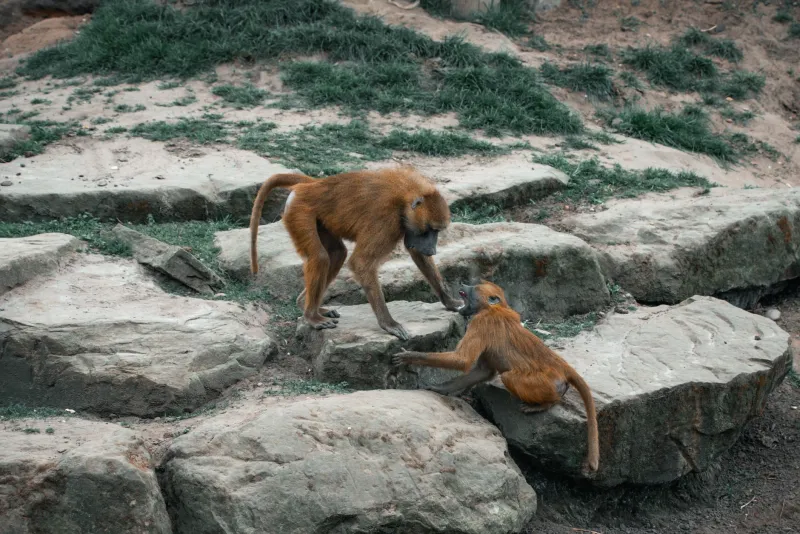
On a damp November morning at many UK zoos, the crowds drift towards the indoor exhibits and the hot chocolate queue. The primates often have other ideas. Watch a group of young macaques, lemurs or colobus for twenty minutes and you may see chasing, rolling, mock biting and the odd dramatic tumble into a pile of siblings. It can look like chaos. It is also one of the most useful everyday signals of primate welfare we have, and it is available to anyone with patience, a notebook and a bit of restraint.
Why play deserves a second look
Welfare is not just the absence of stress. A primate that is free from pain and conflict but has nothing to do, no social partners and no chance to behave naturally is not necessarily thriving. Play is a voluntary, repeated, often exaggerated behaviour that appears to have no immediate survival payoff. That is exactly what makes it interesting. In young primates, rough-and-tumble play and social play are thought to help build motor skills, social confidence and flexibility. They also give keepers a window into group dynamics.
This matters in the UK context. Zoos are licensed and inspected, and collections accredited by BIAZA work to welfare standards that consider behaviour, health and environment. Positive indicators such as play, exploration and calm social contact sit alongside the more familiar warning signs. A juvenile primate that feels confident enough to initiate a wrestle, pause, reverse roles and come back for more is showing something worth recording.
That said, play is not a magic welfare score. A sleepy juvenile is not automatically unhappy, and a playful one is not automatically thriving. Species, age, temperature, group structure and individual personality all matter. Play is one clue among many, not a diagnosis in a notebook.
Reading the play face without overclaiming
The play face is one of the best-known signals in primate behaviour: a relaxed, open-mouthed expression, often accompanied by a breathy panting sound. It is not a human smile, and it does not mean the animal is happy in the way we use the word. It is a signal that says, roughly, this is not a serious fight. Many primates use it during play, but not all species are equally expressive, and juveniles may be less skilled at signalling than adults.
Look for the whole package, not just the mouth. Play often includes bouncy or exaggerated movements, head bobbing, chasing with pauses, rolling, wrestling, and inhibited biting. A larger or stronger animal may self-handicap: holding back, lying on its back, letting the smaller partner climb over it, or deliberately putting itself in a vulnerable position. That is not weakness. It is a social skill, and it helps keep a rough game from turning into a real one.
Context is everything. Two young primates wrestling in a relaxed group, with play signals and chances to break away, are probably playing. One animal pinned and screaming while the other stares and bites is not play. The tricky middle ground is why beginners should record what they see rather than announce what it means.
A simple, ethical recording method
You do not need a research degree to collect useful observations. You do need to stay on the visitor side of the barrier, follow all signage, and avoid doing anything that changes the animals' behaviour. No tapping glass, no calling, no waving food, no flash photography, no blocking walkways. If an animal seems distressed or a situation looks unsafe, find a member of staff rather than trying to intervene.
A straightforward approach is a ten-minute focal sample. Pick one juvenile if you can identify it reliably, or scan the whole juvenile age class if the group is small. Every thirty seconds, note what the animal is doing: play, rest, feed, travel, social grooming, aggression, other. Add a few useful details: date, time, species, enclosure, weather, visitor noise level, and whether play signals were visible. A tally sheet on paper or a notes app is fine. Keep it simple enough that you can repeat it.
Consistency beats complexity. Ten minutes on three different visits, at roughly the same time of day, is more useful than an hour of excited one-off notes. Record what you actually saw, not what you hoped to see. If play stopped when a keeper entered, write that down. If an adult intervened, note it. If you could not tell whether a bite was inhibited, say so.
What keepers can learn from juvenile social behaviour
Keepers already watch this kind of behaviour closely, often with years of context that a visitor will never have. Citizen observations are most useful when they are modest and specific. A note that two juvenile lemurs repeatedly initiated play after a new enrichment item was added is more helpful than a general claim that the animals seemed happy.
Juvenile play can act as a social barometer. Changes in who plays with whom, how often play is initiated, or whether play is interrupted by tension can prompt a keeper to look closer at group compatibility, enclosure layout or enrichment. Play also shows how young animals use space: a juvenile that races along a high rope, rolls in deep substrate and wrestles on a wide platform is telling you something about the enclosure's affordances. None of this replaces formal welfare assessment, but it adds texture.
If you are visiting as a student, ask staff whether they want observations shared. Some collections have citizen science projects or student partnerships; others do not. Never post a clip online with a confident welfare verdict attached. Share it with the people who know the animals, and let them interpret it.
Wrestling or fighting? How to avoid misreading play
Play and aggression can look similar, especially at a distance. Play usually has loose, bouncy movement, play signals, role reversal, pauses, inhibited bites and a willingness to re-engage. Aggression tends to be stiffer and more direct: tense posture, staring, loud screams, one animal fleeing or trying to escape, and no playful return. Real fights can be brief and noisy, but they often leave one animal avoiding the other afterwards.
Juvenile play can escalate. A game may get too rough, an animal may squeal, and an adult may step in. That does not automatically mean the play was bad. Watch what happens next. If the animals separate, pause and then resume with signals, it was probably within normal bounds. If one animal remains fearful or injured, that is a different matter. When in doubt, record the sequence and ask staff. Do not shout, tap the glass or try to break it up yourself.
Next time you visit
Take a notebook, pick a juvenile, and give it ten quiet minutes. Look for play faces, self-handicapping, pauses and reciprocal roles. Note the context rather than rushing to a verdict. The small bodies doing big, silly tumbles are not just entertainment. They are part of the welfare picture, and they are visible to anyone willing to watch carefully and respectfully.