Old Labels, Real Ranges: How to Read a Primate Drawer in a UK Museum
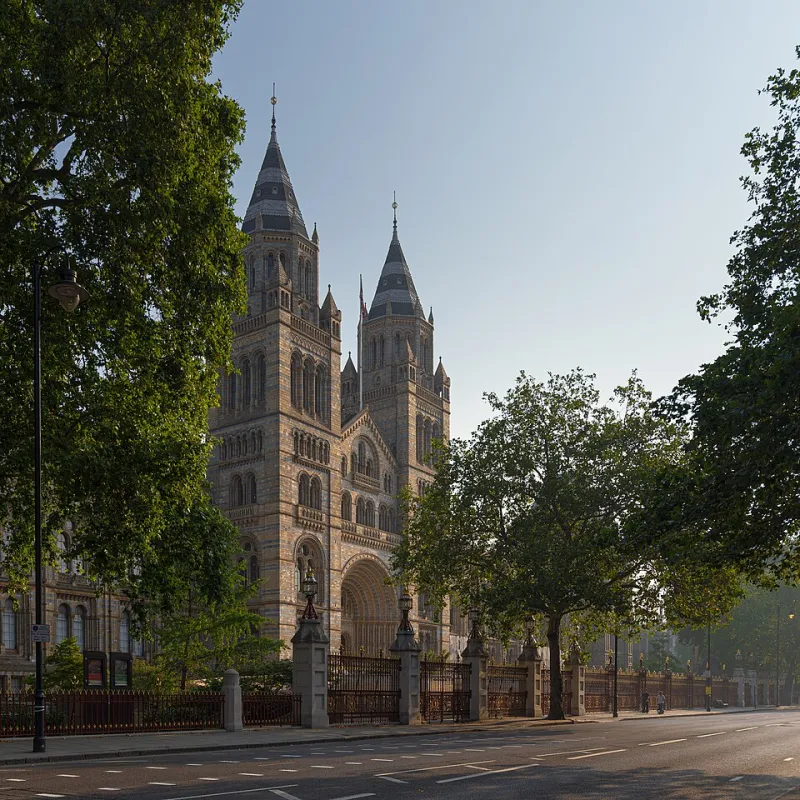
Photo: Julian Herzog (Website), CC BY 4.0, via Wikimedia Commons
Most people visit a natural history museum for the whales hanging from the ceiling. Fair enough. But the genuinely strange, slightly secretive part of any UK collection is upstairs, or out in a purpose-built store in the suburbs, where the cabinets full of primates live in the dark. Tring, Oxford, Manchester, Cambridge, Leeds, Edinburgh, Glasgow — they all have them, and almost none of it is on display.
That's a shame, because a museum drawer is one of the most useful things a student of primate conservation can learn to read.
What's actually in the drawer
Open one and you might find flat skins folded like shirts, skulls in little cradles, articulated skeletons, a taxidermy mount that has gone slightly wrong around the face, or a glass jar of something pale suspended in alcohol. Each object carries a label, and the label is the point. It should tell you what the animal was called, who collected it, when, and where.
It rarely tells you all of that neatly. A typical Victorian label might read Cercopithecus sp., West Africa, no date, no collector. That's the reality of historical collections: beautiful objects, patchy data. Learning to work with patchy data is, honestly, half of conservation science.
Locality is the gold
If you only take one thing from a specimen label, take the place. A skin from a named forest reserve in 1911 is a fixed point in space and time. Stack a few hundred of those together and you can start asking questions that no living animal can answer — was this species here before the road went in? How far west did it actually reach? When did it stop being recorded in this district?
This is how historical baselines get built. Modern field surveys tell you where a primate is now. Museum specimens tell you where it used to be, which is often a much less comfortable map. A drawer of guenons from a country that has since lost most of its lowland forest is not a nostalgic object; it's evidence.
Practical tip: compare the label locality against the current range map for that species. Where the dots fall outside the modern polygon, you've found either a genuine historical record, a taxonomic mix-up, or a locality that was vague to begin with. All three are worth chasing.
Names change; the animal doesn't
Species names get rewritten constantly. What a 1930s collector labelled a single species of mangabey might now be split into two or three, and the specimen may be one of the few physical proofs of where the split happens. Re-identification of old material is quiet, unglamorous work that occasionally reshuffles a whole genus.
When you look at a label, look for revisions. Museums often pencil the new determination onto a second slip, sometimes with initials and a year. That little slip is a record of scientific thinking changing, which is exactly what the collection is for.
Yes, they still sample them
Destructive sampling — taking a sliver of skin, a tooth, a fragment of bone — is tightly controlled, but it happens. Stable isotope work can hint at diet and geography. Genetic work can confirm identity or reveal unexpected diversity. Even the parasites still clinging to a century-old pelt have been used to reconstruct host relationships.
If you're a student hoping to get involved, the route in is usually through digitisation rather than dissection. Big UK collections are steadily photographing and transcribing their labels, and transcription projects are a genuine way for a volunteer to contribute. Reading a hundred handwritten labels is boring; reading a hundred handwritten labels that nobody has touched since 1897 is oddly thrilling, and it makes the data usable for everyone else.
The awkward parts
Primate collections in the UK are also archives of empire. Many were gathered during colonial collecting expeditions, sometimes shot for sport, sometimes traded, sometimes taken without any meaningful consent from the communities whose forests they came from. Provenance research is now a serious strand of museum work, and questions about repatriation and shared stewardship are live ones in 2026, not fringe ones.
Being a good reader of a drawer means holding two things at once: this specimen is scientifically valuable, and the way it got here matters. Both can be true. The label usually tells you more about the collector than about the animal — and that's information too.
Your five-question drawer audit
- Where, exactly? Country only, or a named place? Precision tells you how much weight the record can bear.
- When, and by whom? A date and a collector name let you cross-check with expedition archives and diaries.
- Has the identification been revised? Look for second labels, pencil, initials.
- What's missing? No locality means limited use for range work, but still useful for morphology or genetics.
- What does it make me want to check? A specimen is a prompt, not a conclusion.
Why it still matters
Conservation in 2026 runs on baselines, and baselines run on old data. Satellites can show you a forest disappearing this decade, but only a drawer in Manchester can tell you what lived there when the forest was whole. Next time you're near a museum with a natural history department, ask whether they run tours of the stored collections. Many do, and they're usually undersubscribed. Go and look at the labels. They're better reading than you'd expect.