Alpha, Aggressive and Ape-Like: A Glossary for Sceptical Readers of Primate News
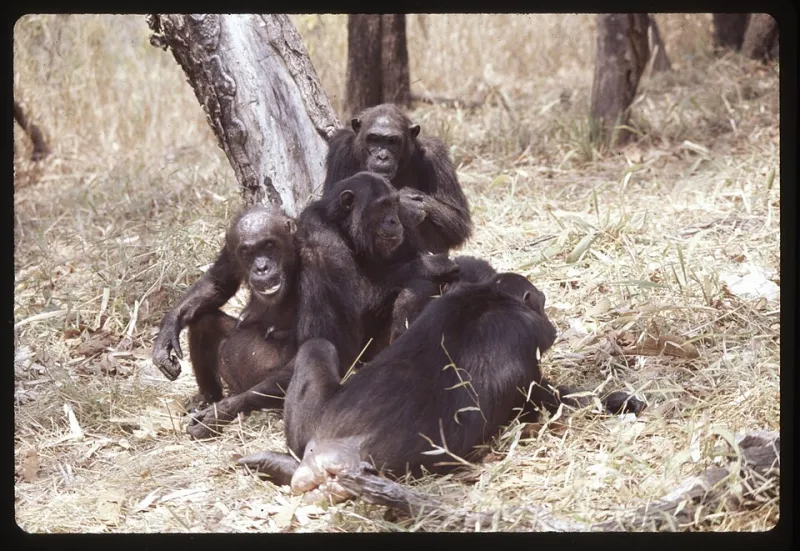
Photo: Garst, Warren, 1922-2016, photographer, CC BY-SA 4.0, via Wikimedia Commons
Every few months a primate story does the rounds in the UK press, and every few months it arrives wearing the same costume: a dramatic noun, a verb borrowed from a crime report, and a quote from someone describing a chimpanzee as 'just like us'. The research underneath is often careful. The language on top frequently isn't.
This isn't a rant about journalists. It's a glossary — a short list of terms that get stretched in coverage, what they actually mean in the behavioural literature, and where the stretchiest bits usually occur. Useful for essays, useful for classrooms, useful for arguing with your uncle at Christmas.
Alpha
What it means: In the old wolf literature, 'alpha' described a breeding pair at the top of a pack. In primatology, dominance hierarchies are real, measurable, and usually described in terms of who wins contests over food, mates or space — not who is a wise leader with a management style.
Where it misleads: 'Alpha male' has been colonised by lifestyle content and now carries a whole cargo of assumptions about leadership, toughness and natural order. Chimpanzee and gorilla males do compete for status, but the outcome is shaped by coalitions, female choice and circumstance. Calling one animal 'the alpha' and stopping there tells you almost nothing about how the group actually works.
Aggressive
What it means: Behaviour intended to threaten or harm — charging, biting, chasing, displays.
Where it misleads: Headlines love this word because it sounds like a verdict. But most primate conflict is low-intensity, brief, and followed by reconciliation. A great deal of communication that looks alarming to a human — a bared-teeth display, a loud pant-hoot, a branch-shaking charge — is precisely how animals avoid an actual fight. Describing a species as 'aggressive' because it has a visible dominance system is like describing a town as violent because it has a traffic code.
Reconciliation and affiliation
What it means: Reconciliation is post-conflict friendly contact — grooming, embracing, sitting close — that repairs a relationship. Affiliation covers the friendly behaviours generally: grooming, huddling, sharing proximity, playing.
Where it misleads: Not a stretch, so much as an omission. Coverage of primate conflict is abundant; coverage of the peaceful repair that usually follows is thin. If you only ever read the fight stories, you get a badly skewed picture of primate social life.
Monkey see, monkey do
What it means: In behavioural science, imitation is copying the method of an action; emulation is achieving the same outcome by your own route. They are different cognitive achievements, and teasing them apart takes careful experimental design.
Where it misleads: The phrase is used as a cute shorthand for social learning in general, which flattens a genuinely interesting question — does this animal understand what I'm doing, or just that a nut came out of the box? A story headlined 'monkeys copy humans' is often a story about an animal that learned a box opens.
Human-like
What it means: Nothing technical. It's a comparison dressed as a measurement.
Where it misleads: Constantly. Primates share evolutionary history with us, and that shared ancestry is scientifically fascinating. But 'human-like' is usually a shortcut to a feeling, not a finding. Watch for it attached to tool use, grief, fairness, humour and politics — and then ask what the study actually measured. Bared-teeth displays, for instance, are frequently described in coverage as 'smiles'. In many species they are better read as signals of submission or appeasement. That's a completely different sentence.
Tool use, culture and war
What they mean: Tool use is the manufacture or use of an object to achieve a goal, and it's documented in chimpanzees, orangutans, capuchins and others. 'Culture' in primatology usually refers to socially transmitted, group-specific behavioural traditions. 'War' is a contested label borrowed from human conflict studies for lethal intergroup raiding in chimpanzees.
Where they mislead: The temptation is to treat each as a mirror. Tool use quickly becomes 'they're just like early humans'. Culture becomes 'they have customs, like us'. War becomes a claim about human nature. Each leap skips over the debatable middle where the actual science lives.
Four traps worth memorising
- The single study. One paper, one population, one researcher's interpretation. Science builds in layers, and a headline rarely says which layer you're looking at.
- Wild versus captive. Behaviour in a zoo enclosure and behaviour in a rainforest are not interchangeable evidence. Many stories blur them.
- The invented number. If the article quotes a percentage, check whether it's from the study or from a press release summarising the study. The gap is sometimes wide.
- The anthropomorphic verb. 'Decided', 'plotted', 'mourned', 'laughed'. Each smuggles in a mental state the study may not have tested. Sometimes the verb is defensible; often it isn't.
What better coverage looks like
It looks boring in the best way. It names the species, says where the research was done and how many animals were involved, distinguishes what was observed from what was inferred, and doesn't need a headline with the word 'shocking' in it. Some UK outlets manage this routinely. Many don't.
In the classroom
A simple exercise works well with students: take three primate stories from the same week, underline every behavioural word, and rewrite each one in neutral language. 'Aggressive chimp alpha terrorises troop' becomes 'adult male chimpanzee frequently wins contests over food'. The rewriting is the lesson. Once you've done it a few times, you start noticing the costume before you notice the story.
The glossary isn't about being cynical. Primatology produces genuinely astonishing findings, and the urge to make them vivid is understandable. But vivid and accurate aren't opposites, and clearer words make for better science coverage — in the papers, in the classroom, and in whatever a sanctuary guide tells you over the fence on a wet Sunday.