Nothing Happened, and That Matters: Building a UK Shelf for Primate No-Effect Notes
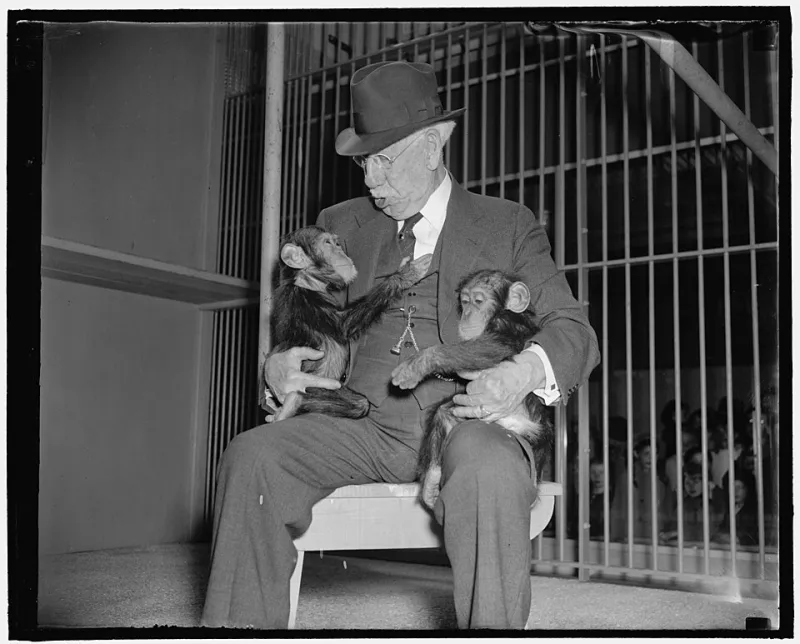
Photo: Harris & Ewing, photographer, Public domain, via Wikimedia Commons
The report that says nothing
Picture the scene. A primate house tries a new enrichment item. The keepers build it, clean it, risk-test it, and watch. After three weeks, the animals use it much as they used the old one. There is no rise in foraging, no drop in pacing, no obvious change in social grooming. The finding is not dramatic. It is not a welfare disaster. It is just a null result.
And then it vanishes.
In UK primate behaviour work, this is a familiar pattern. Positive results get talked about. A new feeding puzzle that reduced aggression becomes a conference slide. A training method that worked becomes a staff note. A no-effect result often becomes a shrug. That is a problem, because the missing 'no' is not a failed study. It is useful evidence. It tells the next keeper, student or welfare researcher that a particular intervention did not produce the outcome people expected, at least in that setting, with those animals, over that period.
For a field that cares about evidence, we are oddly shy about publishing the evidence that says 'not much happened'.
Why the missing 'no' goes missing
Some of this is ordinary publication bias. Journals and newsletters like clear stories. Positive findings are easier to summarise. Null findings can sound like an anticlimax, even when they are methodologically sound. In collections, there is also a practical fear: if we report that an enclosure change made no measurable difference, will it look like we wasted money or did not care? That fear is understandable, but it pushes useful information out of view.
There is a cultural issue too. Primate keeping and welfare work runs on observation, and observation often arrives as anecdote. A keeper says the troop seemed calmer after the new platform went in. That is a reasonable starting point, but it is not the same as a measured change. When the measured result is flat, the anecdote may still dominate because it is more memorable. Over time, the sector can end up with a shared memory of what 'works' that is built on the loudest stories rather than the full set of attempts.
Students feel this acutely. A dissertation project that finds no effect can feel like a dead end. In reality, a well-run no-effect study is a result. It only becomes a dead end if nobody records it.
How to spot a missing negative
You do not need to be a statistician to notice when null results have been quietly left out. Start with the basics.
Look for the baseline. If a report says enrichment improved welfare, ask what the animals were doing before. If there is no before, there is no comparison. Look for the sample. A troop of six monkeys can produce a useful case study, but it cannot support a sweeping claim. Look for the measures. If the report only mentions the one measure that moved, and stays silent on the four that did not, that is a missing negative.
Watch the language as well. Phrases like 'a trend towards improvement' or 'keepers felt there was a positive change' may be honest, but they are not the same as a clear effect. They deserve to sit alongside the results that did not budge. A good rule of thumb is simple: if a study lists what changed, it should also say what did not.
This matters for welfare claims. If a collection says a new enclosure feature 'reduced stress', a sceptical reader should be able to see which behaviours were measured, over what period, and whether any measures showed no change. That is not nitpicking. It is how animal welfare evidence becomes trustworthy.
What a 2026 no-effect shelf could look like
A UK no-effect register does not need to be grand. It could be a shared online repository, hosted by a sector body or a university partner, with a one-page template. The fields could be deliberately boring: species, setting, intervention, duration, what was measured, what happened, sample size, and any caveats. Add a contact field and a date. That is enough to make the entry findable.
The key is scope. This should not be a place for every stray observation. It should be a shelf for planned changes or studies where someone looked for an effect and found none worth reporting in the usual channels. A new feeding schedule. A change in lighting. A training protocol that stalled. A social grouping that produced no measurable shift in grooming or aggression. These are exactly the things that currently get repeated across collections because nobody knows the last place tried them.
A 2026 pilot could run for six months with a handful of participating collections and a student moderator. Entries could be short and plain. No scores, no rankings, no public shaming. Just a searchable record of what was tried and what did not show up. That would already be a useful counterweight to the positive-result echo chamber.
The box-ticking trap
There is an obvious risk. Give UK primate organisations a new form and someone will turn it into a compliance task. Before long, staff are filling in no-effect notes to satisfy a spreadsheet rather than to share knowledge. That would miss the point.
So keep it voluntary, low-effort and useful. Make the template shorter than a risk assessment. Let people submit under an organisation name or anonymously, as long as the basic context is there. Allow a delay before publication if a collection wants to check sensitive details. Do not demand perfect statistics. A plain note that says 'we tried this, we measured that, nothing changed, here are the caveats' is better than a blank shelf.
The register should also be read, not just filled. A quarterly digest could pull out common themes: enrichment types that repeatedly show no effect for certain species, training approaches that stall in similar settings, enclosure changes that fail to shift behaviour. That is how null results become practical knowledge rather than paperwork.
Start small, keep it honest
UK primate behaviour work already has strong habits of observation. What it lacks is a modest place to put the observations that did not turn into a story. A no-effect shelf would not solve every problem in welfare research, and it would not replace proper study design. But it would stop the sector from repeatedly learning the same quiet lesson in isolation.
If you are a keeper, student or researcher with a flat result sitting in a notebook, that result is not nothing. It is a missing 'no' that someone else needs to see. In 2026, a simple UK register could give it a home.